Menkaure’s queen provides the perfect female counterpart to his youthful masculine virility and other features
Smarthistory – King Menkaure (Mycerinus) and Queen, smarthistory.org/king-menkaure-mycerinus-and-queen/. Accessed 23 Sept. 2025.
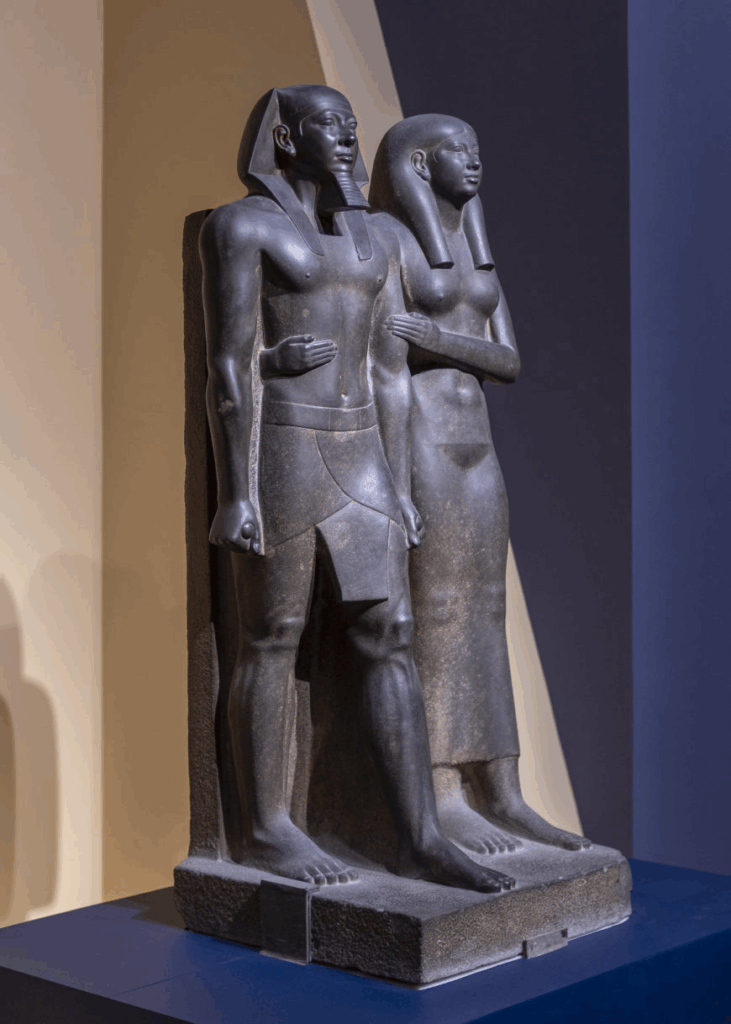
An example of power being shown in ancient Egypt is through a serene statue shown above of the pharaoh, king Menkaure, and his queen from the Pyramid of Menkaure. Both the king and queens body and facial features give striking yet meaningful looks to show their versions of tranquility as well as power. “In his clenched fists, held straight down at his sides, Menkaure grasps ritual cloth rolls. His body is straight, strong, and eternally youthful with no signs of age. His facial features are remarkably individualized with prominent eyes, a fleshy nose, rounded cheeks, and full mouth with protruding lower lip.” (Calvert, 2025) King Menkaure shows power through his features such as how he stands and the way his face is oriented. His Body upright with his left foot in front demonstrating his site into “timeless eternity, displaying no human emotions”. (Calvert, 2025) The queen also demonstrates her power by standing by her kings side perfectly complementing to his “youthful masculinity”.
Smarthistory – King Menkaure (Mycerinus) and Queen, smarthistory.org/king-menkaure-mycerinus-and-queen/. Accessed 23 Sept. 2025.
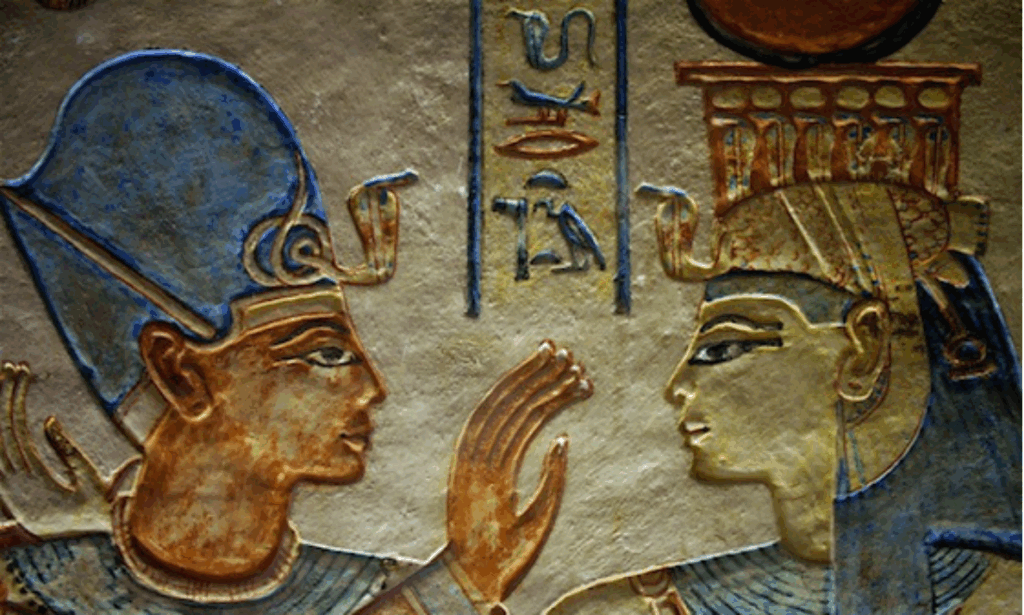
Painted sunk relief of the king being embraced by a goddess. Tomb of Amenherkhepshef (QV 55) (New Kingdom, Ramesside) (photo: Dr. Amy Calvert)
Ancient Egyptian art was not only made for visual satisfaction but for the deceased of the ones whom Egyptians worshiped and looked to for guidance. Numerous amounts of rituals were performed in front of statues like these and were also used for manifestation. “Statuary provided a place for the recipient to manifest” (Calvert, 2013). Paintings on walls like the one shown above as well as statues portray the royalty of the rulers and the amount of power that they held over the people who drew and sculpted these pieces.
Khan Academy, Khan Academy, www.khanacademy.org/humanities/ap-art-history/ancient-mediterranean-ap/ancient-egypt-ap/a/egyptian-art. Accessed 23 Sept. 2025.
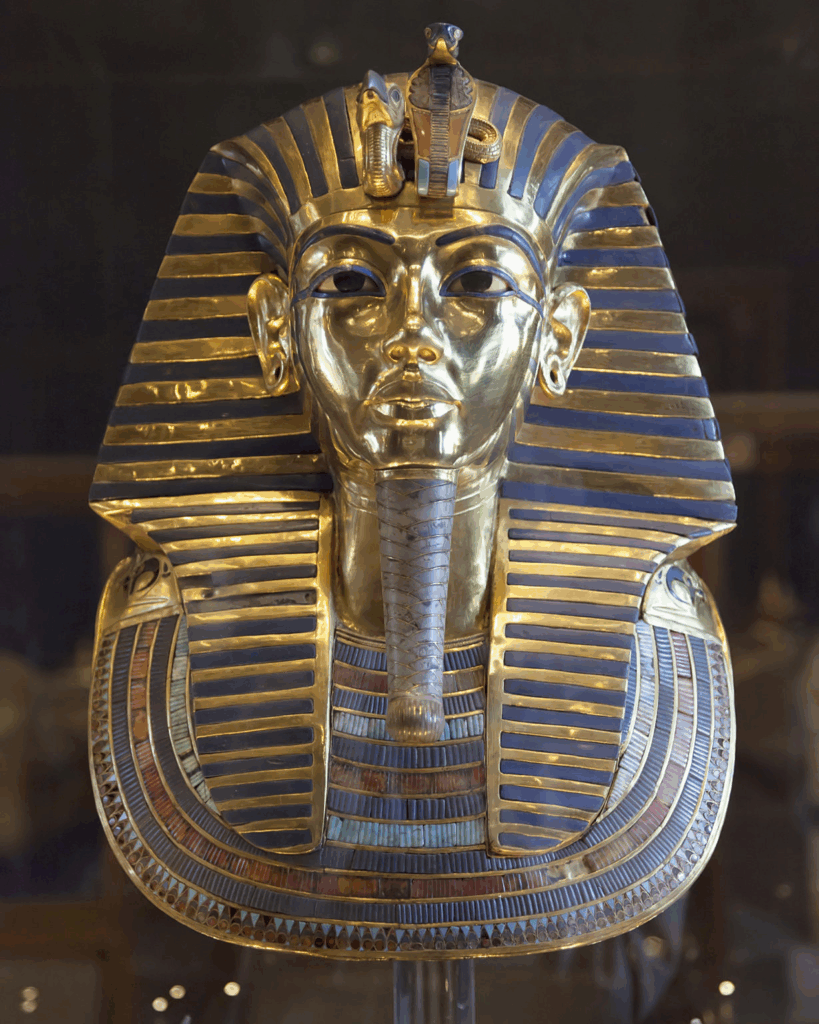
Death Mask from innermost coffin, Tutankhamun’s tomb, New Kingdom, 18th Dynasty, c. 1323 B.C.E., gold with inlay of enamel and semiprecious stones (Egyptian Museum, Cairo) (photo: Roland Unger, CC BY-SA 3.0)
Pharaohs were basically thought of as gods and were figured to look like them as well. “The image of the pharaoh is that of a god. The gods were thought to have skin of gold, bones of silver, and hair of lapis lazuli—so the king is shown here in his divine form in the afterlife” (Cummins, 2025). This quote alone goes to show how the death masks like the one shown above from Tutenkhamun’s tomb portrayed the Egyptians version of power and how well they respected the Pharaohs. Since they saw the pharaohs as gods they used very valuable materials to make these masks/coffins and treated them with full royalty.
Smarthistory – Tutankhamun’s Tomb (Innermost Coffin and Death Mask), smarthistory.org/tutankhamuns-tomb-innermost-coffin-and-death-mask/. Accessed 24 Sept. 2025.