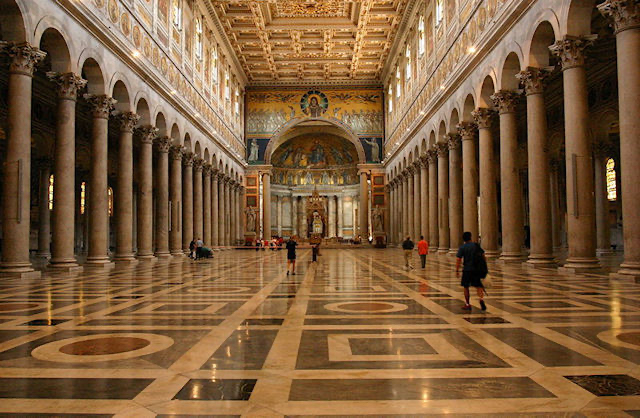
Roman architecture revolutionized buildings through materialistic changes like concrete and arches which enabled spacious interiors such as the Pantheon’s dome. Versus Christian architecture that adapted the Roman basilica, a public building with a long central aisle and curved ends serving as a place for worshipping. Churches like Santa Sabina have added elements like altars and transepts as well. In contrast, Roman religion focused on its impressive public displays and worship of their many gods in gatherings in temples, while early Christians worshiped and rooted in Jewish synagogue practices of scripture reading and prayer. This highlights the focus on the shared worship inside the church, centered around the Eucharist at an altar that represents heaven’s most sacred space. These both shared practical adaptations such as Romans using the basilica for law courts before Christians repurposed it. However, early Christian builders avoided pagan temple designs to distance themselves from old religions and to fit larger groups, while placing saints’ relics beneath altars which was a practice inspired by Revelation 6:9-10. In “An Introduction To Ancient Roman Architecture” Dr. Jennifer Ambler explains how “Roman architecture differed fundamentally from this tradition because of the discovery, experimentation, and exploitation of concrete, arches, and vaulting” (Ambler, 2014). This highlights the engineering concept over the religious scripture in churches where “we can think of the liturgy as the script and the church architecture as the stage upon which it was performed” (Freeman, 2025).
Khan Academy, Khan Academy, 2014, www.khanacademy.org/humanities/ancient-art-civilizations/roman/x7e914f5b:beginner-guides-to-roman-architecture/a/roman-architecture.
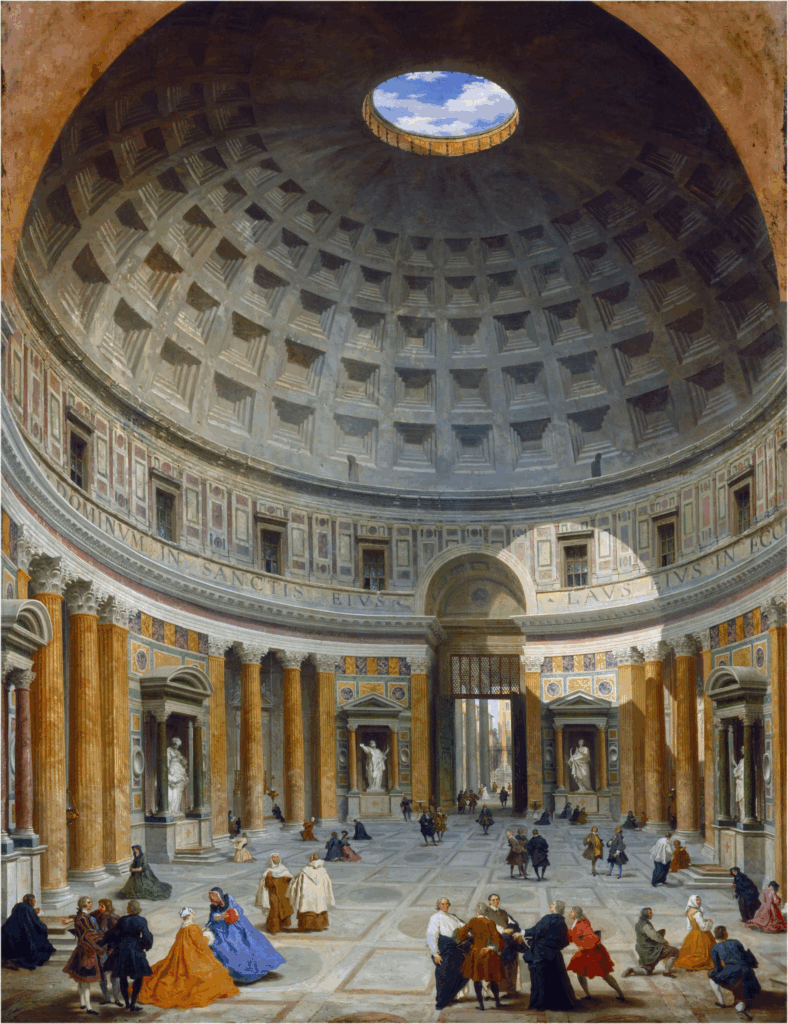
Giovanni Paolo Panini, Interior of the Pantheon, Rome. c. 1734, oil on canvas, 128 x 99 cm
The wall painting styles of ancient Rome and the illuminated manuscript of the Paris Psalter may look very different in their form, but they share interesting parallels and clear contrasts. In an article about Roman Painting Styles, Dr. Jessica Ambler explains “that Roman artists were concerned with how to use the wall surface: for example, “painting illusionistic images” that “trick the viewer into believing that they were looking through a window” (Ambler, 2015). This emphasis on illusion and architectural staging stands in contrast with the Paris Psalter’s idea of symbolism and a combination of Christian narratives along with classical allusion. The Psalter “embodies a complex mixture of the classical pagan past and the medieval Christian present” (Ambler, 2015). The Roman frescoes often rely on deep space, vanishing points and architectural elements in a normal everyday environment. In contrast, the Paris Psalter uses pastoral landscapes, mythic personifications and a purposeful use of ancient visual vocabulary to serve Christian ideology. The Roman wall paintings emphasize the materials luxury looks and illusion such as marbles and wall decorations while the Byzantine manuscript focuses on symbolism, classical style, and religious meaning. Yet both reflect a thoughtful connection to the past. Roman artists borrowed from Greek Hellenistic art in their architectural illusions, and Byzantine artists used Roman and Hellenistic influences to project continuity and power. Ultimately, Roman painting is based on displays and the illusion of space, while the Paris Psalter’s illumination focuses on spiritual stories and symbolism, with both influenced by older artistic traditions.
Khan Academy, Khan Academy, 2015, www.khanacademy.org/humanities/medieval-world/byzantine1/x4b0eb531:middle-byzantine/a/the-paris-psalter.
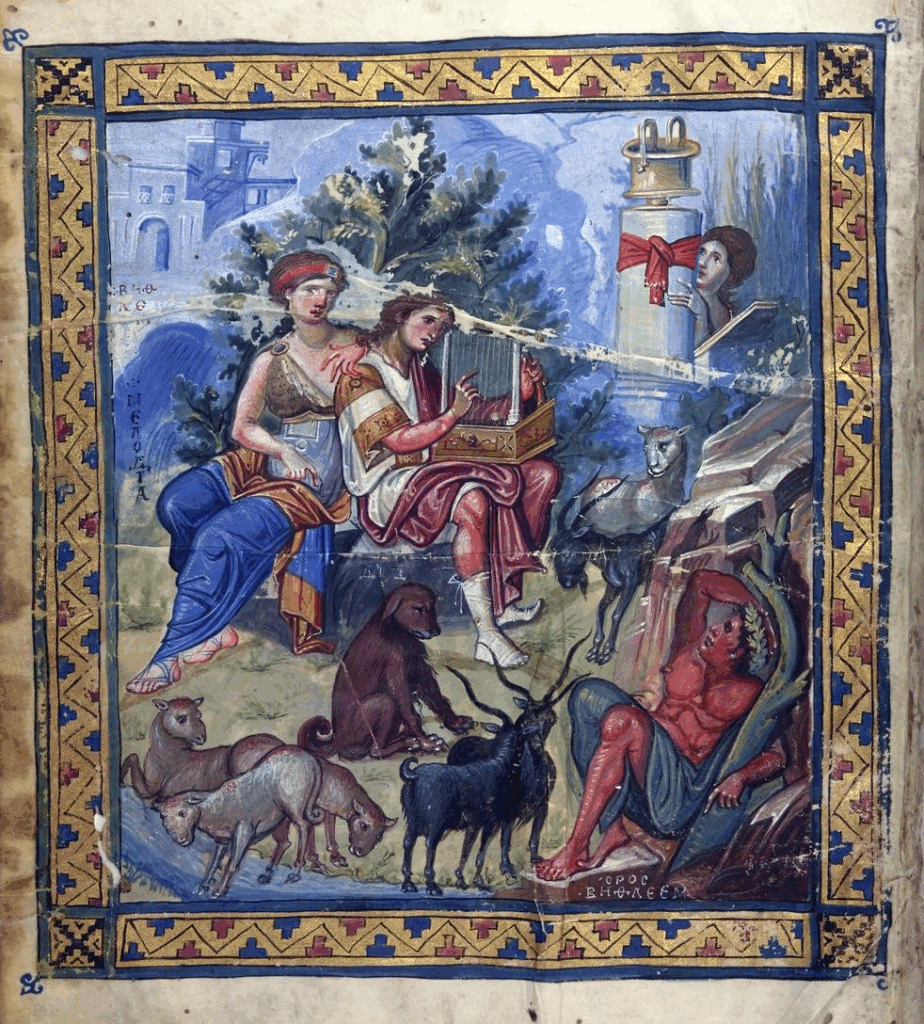
David Composing the Psalms, from the Paris Psalter, c. 900 C.E., folio 1v, 36 x 26 cm