The idea of the perfect body throughout history has gone through countless phases and time periods but one that sticks out more than others is Ancient Greece. During this time the human body was looked at as a temple of beauty and symbolized in various ways. In an article about the sculptures of Polykleitos and Doryphoros, Zucker and Harris explain how Romans not only looked at Greek artifacts as art but looked at them as a way to learn and live life. “Basically, just about every Roman wanted ancient Greek art. For the Romans, Greek culture symbolized a desirable way of life—of leisure, the arts, luxury and learning” (Harris & Zucker, 2014). To this day I think people from all around the world think in the same manner because almost everyone has a perception of the perfect body. Whether it is someone who wants to be fit and in shape or someone who thinks their body is beautiful no matter what because true beauty lies within and not outside. Our ideas of beauty and perfection vary through society and will never all be the same.
Khan Academy, Khan Academy, 2014, www.khanacademy.org/humanities/ancient-art-civilizations/greek-art/classical/a/polykleitos-doryphoros-spear-bearer?modal=1.
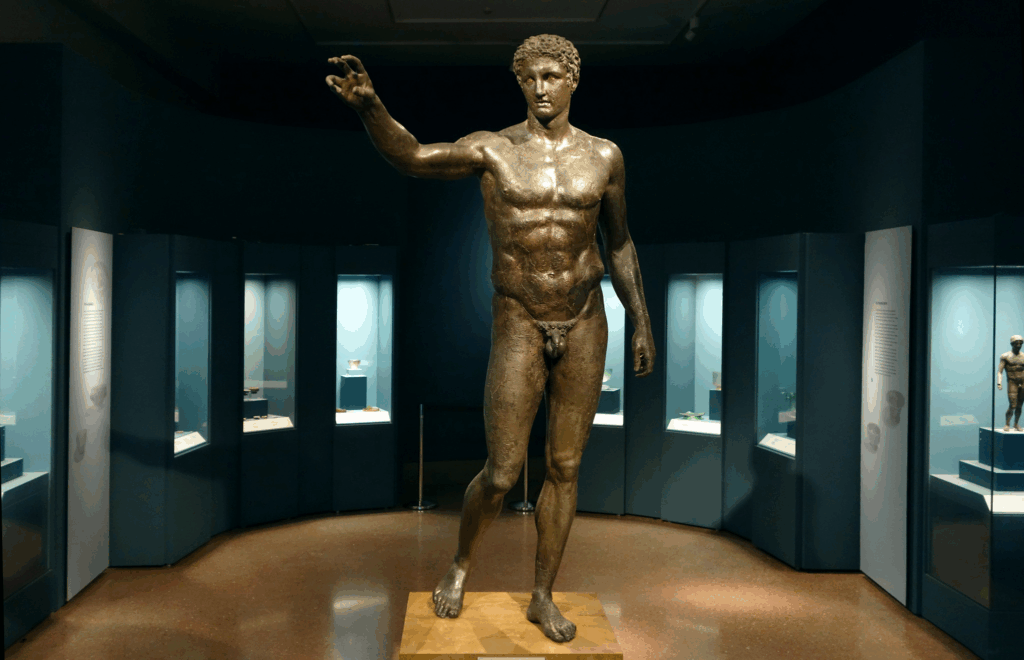
Example of original Greek bronze sculpture, Antikythera Youth, 340–330 B.C.E., bronze, 1.96 m high (National Archaeological Museum, Athens, photo: Steven Zucker, CC BY-NC-SA 2.0)
Another piece of Greek art that represents perception and the evolution of beauty in the human body is the statue of Kouros. The statue is a nude man made of marble standing up right with one foot in front of the other. In a Khan Academy video narrated by Harris and Zucker, they both gave their views on this piece and the meaning behind it saying “It is instead a symbol, an ideal of manhood, of perfection”(Harris & Zucker, 2014). With this ancient artifact it demonstrates how till this day we still think and look at beauty in art as a symbol of strength and even as one’s dream. It gives us the idea and mindset to achieve whatever we may want to accomplish such as building your ideal physique.
Khan Academy, Khan Academy, 2014, www.khanacademy.org/humanities/ancient-art-civilizations/greek-art/daedalic-archaic/v/kouros-youth-archaic-greek-c-590-580-b-c-e.
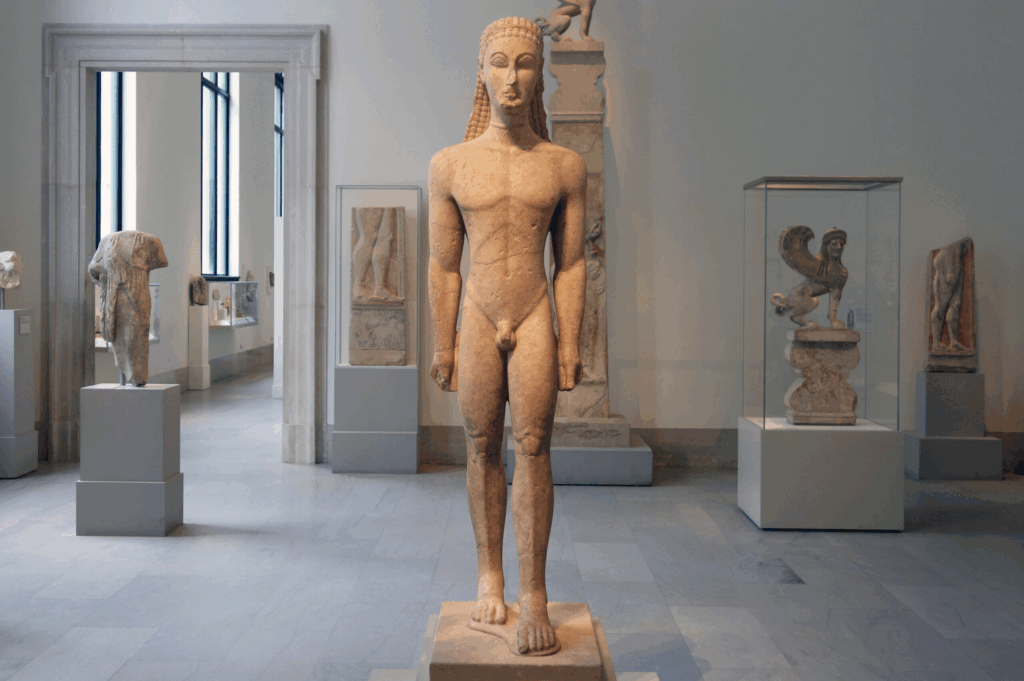
Smarthistory – Marble Statue of a Kouros (New York Kouros), smarthistory.org/marble-statue-of-a-kouros-new-york-kouros/. Accessed 8 Oct. 2025.
As time passed, the art of the human body in Ancient Greece evolved and started to look more peculiar and in my opinion far more fascinating. An example of this was shown in another video narrated by both Harris and Zucker. They talked about the “Discuss Thrower” and its unique qualities and how it is different than other sculptures and pieces. The Discuss Thrower wasn’t sculpted to stand upright, it was made to be in a throwing motion to capture the action of the thrower. In the video, Harris and Zucker discussed how it demonstrated balance within the body but also capturing a glimpse of its beauty at the same time. “To capture the aesthetic qualities, the sense of balance and harmony and the beauty in the proportions of the body” (Harris & Zucker, 2013)
Khan Academy, Khan Academy, 2013, www.khanacademy.org/humanities/ancient-art-civilizations/greek-art/classical/v/myron-discobolus-discus-thrower-roman-copy-of-an-ancient-greek-bronze-from-c-450-b-c-e?modal=1.
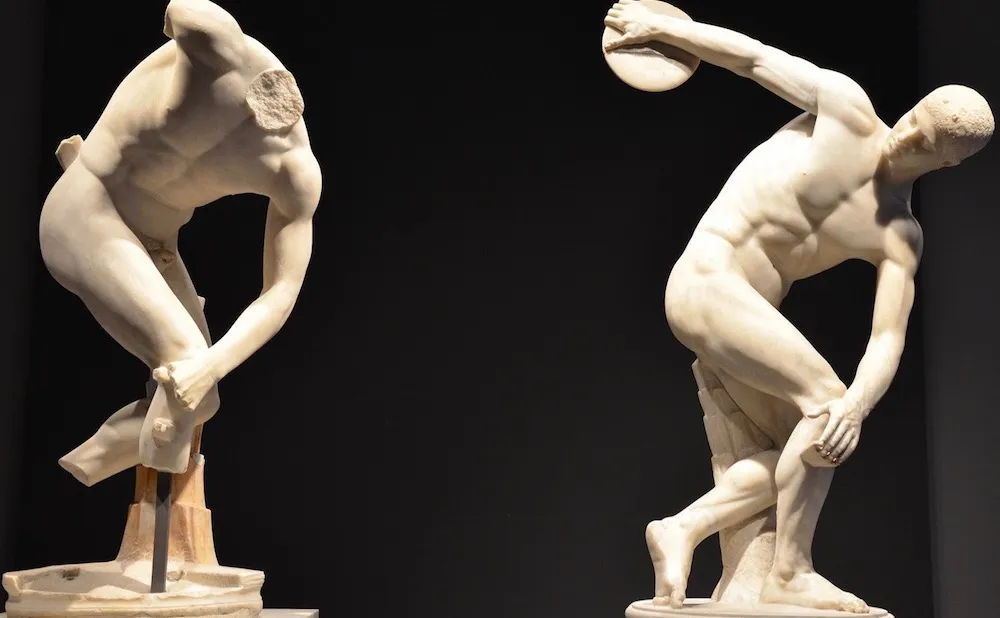
Bond, Sarah E. “The Political Uses of a Figure of Male Beauty from Antiquity.” Hyperallergic, 18 Sept. 2025, hyperallergic.com/447769/the-political-uses-of-a-figure-of-male-beauty-from-antiquity/.